
Three Career Skills Students Need in an AI-Shaped Job Market

Last reviewed 4 November 2026
Students preparing for an AI-shaped job market should build three connected skill groups: role-specific technical skills, adaptable problem-solving skills, and human judgment. A strong graduate profile does not merely list them. It proves them through projects, work, competitions, clubs, or placements that show a problem, a decision, a result, and supporting evidence.
Key findings
- McKinsey estimates that more than 70 percent of US workers could need substantial skill development by 2030.
- Since 2022, demand in US job postings has risen 11 times for AI fluency, five times for adaptability, and three times for resilience, curiosity, and willingness to learn.
- In PwC research covering more than 9,000 entry-level workers across 48 countries, 28 percent believed that half or fewer of their current skills would remain relevant in three years.
Source: Original Stride illustration.
The labour market is changing faster than job titles
The McKinsey Global Institute report Workforce in motion, published on 29 September 2026, estimates that roughly 11 million US workers may need to change occupations by 2030. It also finds that only about one in seven workers in roles at risk of displacement has a direct pathway into a more resilient or growing occupation.
That gap matters because a degree title alone does not show how a person can move into changing work. Employers need evidence that a candidate can learn tools, understand a business or technical problem, work with others, and turn information into a useful result.
The report's authors, including Marco Dondi, Julia Klier, and Kweilin Ellingrud, frame the challenge around skills and pathways rather than a simple list of disappearing jobs. That is useful for students because skills can be developed and demonstrated before a first full-time role.
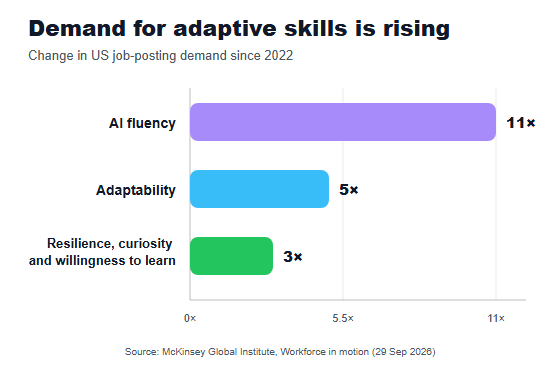
Source: McKinsey Global Institute, Workforce in motion, 29 September 2026. Values describe change in demand within US job postings since 2022.
1. Essential skills make someone useful in a target role
Essential skills are needed to perform the work. For a business analyst, they may include requirements gathering, process mapping, stakeholder interviews, spreadsheet analysis, SQL, and dashboarding. For a software or computer science role, they may include programming, version control, testing, debugging, system design, and secure development practices.
A skill becomes credible when attached to evidence. A business student could map a club's unclear event process, document pain points, propose a new workflow, and record what changed. A computer science student could build a small service, publish the repository, add tests, explain the architecture, and document a remaining limitation.
A strong project entry answers four questions:
- What problem existed?
- What did the student personally decide or build?
- What evidence shows the result?
- What would be improved next time?
2. Enabling skills show adaptability
McKinsey's job-posting analysis highlights AI fluency, adaptability, resilience, curiosity, and willingness to learn as rising signals.
AI fluency is not merely prompting a chatbot. It includes choosing an appropriate task, checking output, protecting sensitive information, identifying uncertainty, and explaining where human review was required. Adaptability is best proved through a change, such as revising an analysis after stakeholder feedback or replacing a technical approach when the data was incomplete.
PwC's research on entry-level work in the age of AI, published on 25 June 2026, combines global labour data, senior-leader interviews, and a survey of more than 9,000 entry-level workers in 48 countries. It found that 28 percent believed half or fewer of their current skills would remain relevant in three years.
PwC Global People and Organisation Leader Peter Brown argues that positive outcomes are not automatic. They require deliberate AI adoption, investment in entry-level talent, and capability building. For students, the practical lesson is to use AI to deepen the work and its explanation, not to hide the absence of work.
3. Empowering skills turn capability into trust
Communication, judgment, collaboration, and initiative help people apply knowledge responsibly with others. They can be proved with a decision log, stakeholder feedback, a presentation for a non-technical audience, a team retrospective, or a limitation that changed the recommendation.
Apple's student careers stories connect early-career learning with contribution and collaboration. Y Combinator's student career advice makes a related point. Ryan Choi describes internships as places to test interests and deliberately develop skills, and suggests adjacent roles that build a missing capability, such as an analyst role that develops SQL.
The useful lesson is not the company name. It is that an early role should be judged by the skills and evidence it creates, not only by its title.
Turn a project into evidence
| Evidence layer | Business example | Computer science example |
|---|---|---|
| Problem | A manual reporting process creates delays | A service fails under a defined load |
| Method | Interviews, process map, requirements, analysis | Architecture, implementation, tests, benchmarks |
| Decision | Prioritise one workflow change and explain the trade-off | Select one design and document alternatives |
| Result | A usable dashboard or approved recommendation | A working prototype with measured behaviour |
| Reflection | Limits, feedback, and next step | Risks, technical debt, and next step |
Source: Original Stride framework, informed by McKinsey Global Institute, PwC, Apple, and Y Combinator.
Students unsure which project to choose can start with a career roadmap, compare real job advertisements, and select one recurring skill gap. The next project should close that gap and produce something inspectable. See also how to match skills to AI-changed jobs.
What strong evidence looks like in practice
Business example: improving an event approval process
A business student working with a university club might notice that event approvals move through scattered messages, spreadsheets, and verbal decisions. The project could begin with short stakeholder interviews and a current-state process map. The student could then identify repeated handoffs, unclear ownership, and missing information before proposing a simpler future-state workflow.
The portfolio evidence would include the process map, requirements, a decision log, and stakeholder feedback. The result should be described honestly. If the proposal was reviewed but not implemented, the portfolio should say so. That is still useful evidence because it shows investigation, synthesis, communication, and an understanding of implementation limits.
A recruiter can inspect this example and see more than “process mapping” on a skills list. They can see how the student defined the problem, worked with people, selected an approach, and responded to feedback.
Computer science example: building a reliable student service
A computer science student might build a small service that helps students track application deadlines. The technical evidence could include the repository, architecture diagram, data model, tests, deployment notes, and a short explanation of privacy and failure handling.
The strongest version would also document a decision. For example, the student might compare two notification approaches, choose one based on reliability and complexity, and explain what would need to change before the system handled real personal data. If testing reveals a limitation, that limitation belongs in the case study rather than being hidden.
This example proves more than programming ability. It shows technical judgment, verification, written communication, and responsible use of data. If AI assisted with code or documentation, the student should identify where it was used and explain how the output was checked.
In both examples, the portfolio becomes more credible when artifacts are connected to the explanation. Claims such as “strong communicator” or “adaptable problem solver” become conclusions a reviewer can draw from the work, rather than statements the reviewer is simply asked to accept.
The takeaway
The research does not show that every student must become an AI specialist. It shows that technical capability, adaptability, and human judgment are becoming harder to separate.
The strongest evidence follows a simple sequence: problem, action, result, feedback, and improvement.
Frequently asked questions
Which career skills should students prioritise?
Role-specific technical skills, adaptable problem solving, AI fluency, communication, and judgment. The exact technical skills depend on the target occupation.
Does every student need to learn coding?
No. Coding is essential for some roles, useful in others, and not a universal requirement. Real job advertisements reveal what a target role repeatedly requires.
What counts as evidence of a skill?
A project, report, repository, process map, dashboard, competition submission, presentation, applied certificate, stakeholder feedback, or documented decision can all be evidence when the person's contribution is visible.
Method and limitations
This article synthesises official materials from McKinsey, PwC, Apple, and Y Combinator. McKinsey's figures focus on the United States. PwC's survey covers 48 countries but reports aggregated results. Apple and Y Combinator provide illustrative career guidance rather than population-level evidence. These sources indicate patterns, not the outcome of an individual student, occupation, or country.
Sources and last reviewed
Last reviewed: 4 November 2026
- McKinsey Global Institute, Workforce in motion: Skills and pathways to future jobs in the United States, published 29 September 2026.
- PwC, AI and the future of entry-level work, published 25 June 2026.
- Apple, Students at Apple, accessed 4 November 2026.
- Y Combinator, Career and Resume Advice, Student Edition, published 11 August 2020.
Stride is not affiliated with McKinsey, PwC, Apple, or Y Combinator.